Choosing the right packaging for international shipments can be the difference between your goods arriving in perfect condition and having to file costly damage claims. This guide is here to help UK exporters make informed decisions about wooden packing cases, covering everything from construction and compliance to some very practical packing techniques.
A wooden packing case is essentially a fully enclosed timber container, built to protect goods during transit, in storage, and when they’re being exported. Wooden packing crates and wooden shipping crates basically serve the same purpose: to give your items robust protection – whether that’s a precision electronics to heavy machinery.
Now the key difference between these types of crates lies in the way they’re built. Wooden cases are fully enclosed with solid panels, whereas wooden crates often have slatted or part-open sides with battens to let in some ventilation and visibility. And then there are simple pallets which don’t have any enclosing walls. For example, a fully enclosed case will keep a £20,000 oscilloscope safe from dust and impact – whereas a slatted crate would be much more suitable for 1,500kg automotive pumps – the airflow keeps the moisture at bay.
Wooden export crates are robust containers made from timber, including plywood, OSB and chipboard – which is why they’re popular for packaging and transporting industrial parts during international shipping. Typically, the board thickness ranges from 18mm to 22mm and the standard internal dimensions are pretty much aligned to the Euro-pallet footprints – 1200x800mm or 1200x1000mm. These types of crates can be used for UK and EU exports via sea freight, air freight, or even for long term storage in warehouse racking.
Wooden packing cases: Fully enclosed and basically ideal for fragile items and sensitive equipment
Wooden shipping crates: Can be slatted – suitable for robust items that need some inspection access
Cardboard boxes: Lightweight and cost-effective for parcels under 30kg – but really not suitable for heavier items
Pallets: Good for elevating goods and making handling a bit easier – but they offer no protection or enclosure
When UK businesses are deciding on which packaging to use for exporting their goods, they’re often pitting wooden cases against cardboard boxes and trying to figure out which one is the best fit. And the thing is, it all comes down to weight, value, journey length and what kind of handling conditions the goods are going to face.
Choose wooden packing crates over cardboard boxes when: loads exceed 500kg, items are fragile or high-value, or when shipments face long sea journeys with rough handling
Cardboard boxes are good for: lightweight parcels under 30kg, air freight where weight directly impacts shipping costs, and for e-commerce goods that need to arrive next day
Wood is much more robust than plastic or cardboard – it keeps contents safe from shocks, impacts and environmental damage—and that’s better for demanding applications
Plastic crates: Have the advantage of being reusable (up to 30 cycles) – but cost 20-30% more for large volumes
Aluminium cases: Offer high security for ultra-high-value items – but at 3-5x the price
GRP containers: Are more resistant to corrosion – but weigh 50% more and that’s only going to increase freight charges
Security comparison: Wooden crates with nailed lids and steel banding are a bit more secure – than cardboard which can easily tear
Stackability: Wooden crates can handle 2-3 tonnes per square metre – whereas cardboard can only handle 500kg
UK exporters typically use a mix of standard and bespoke wooden packing crates depending on what they need to transport. Getting familiar with the full range of options will help you match packaging to product.
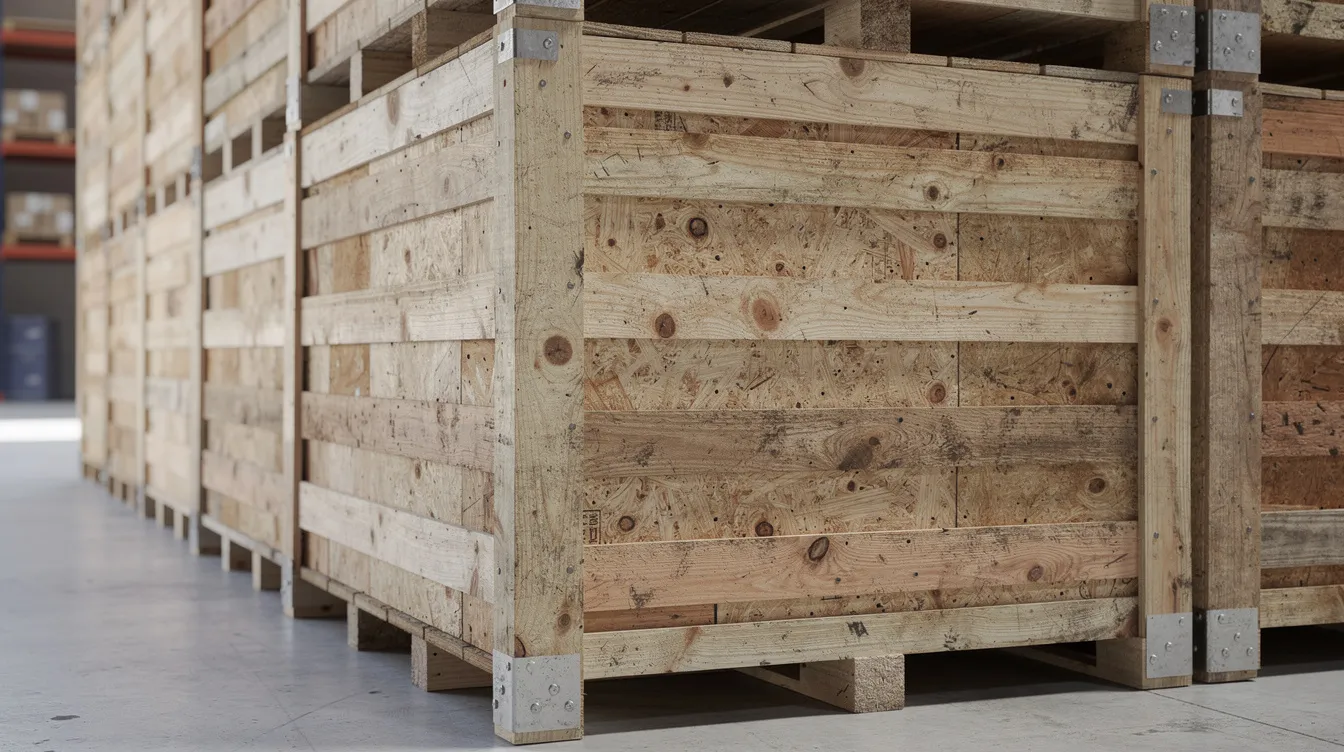
Fully enclosed close-boarded cases: Panelled with 18mm plywood or OSB over timber frames – suitable for sensitive electronics and test equipment that needs complete protection from dust and impact
Open or slatted wooden crates: Timber framing with 22mm battens – suited to robust items like castings and automotive components where inspection access and ventilation are important
Clip-together and collapsible wooden shipping crates: Arrive flat-packed – assemble in 2-5 minutes via those cam locks, and they can reduce storage space by 80% – pretty useful for returnable routes like UK-Germany auto parts
Pallet boxes and pallet collars: Stack atop standard 1200x800mm or 1200x1000mm pallets – forming hybrid packing crates for warehouse overflow or spare parts
Standard sizes: Include 1200x800x1000mm (500kg capacity) and 2200x1000x1200mm (2,000kg capacity)
Custom sizes: Designed around product footprint and height – can really help to optimise container fill – and that means wooden export crates can be customised to suit specific products and applications – this can really enhance protection and save on shipping costs by reducing empty space
Well-designed wooden shipping crates can really reduce damage and shipping costs by engineering protection around the specific cargo requirements.
Load capacity tiers : for light-duty use in plywood-only construction we can handle up to 500kg , for medium-duty use with framed bearers 1,000kg and for heavy-duty with doubled bearers and cross-bracing we can handle anything over 2,000kg – and remember to always specify a uniform distributed load to prevent tipping at all times
Construction details: we use 18mm thick plywood sides screwed into 100x50mm timber frames using 75mm galvanized nails which gives us a 5G impact resistance rating – and the base is formed with 22mm solid timber bearers to distribute loads properly
For shipping heavy or irregularly shaped items within a crate we often use timber blocks and braces to help secure them during transit and prevent movement
To prevent damage , we always make sure to distribute weight evenly and place the heaviest items at the bottom – this lowers the centre of gravity making it much safer to transport
Internal dunnage : we use foam inserts (50-100mm EVA) and rubber pads to immobilise export goods like motors and control panels , and ratchet straps to keep everything in place
Handling design : has to include some good old fashioned common sense – we fit 100mm-high skids for pallet trucks, crane lifting points (4x M12 eyes rated to 1.5 tonnes each) and racking grooves for warehouse beams
Container loading : a 20ft container is perfect for 11x 1200x800mm crates base-loaded ; 40ft containers allow for stacking up to two high under 1,000kg per unit – it really is all about getting the maximum load in
Make sure you close the crates securely with screws rather than nails – it’s just so much easier for customs to inspect them and it stops the wood getting damaged
Labelling : every crate should have clear, easy-to-read labelling – including “FRAGILE”, orientation arrows, gross/net weights (e.g. 850/750kg) and that all important ISPM 15 IPPC mark – which has to be visible on all four sides
If you’re shipping internationally you have to make sure your wooden packing is compliant with ISPM 15 – anything that isn’t is at risk of being rejected at the destination port, or worse still , being fumigated – which costs a fortune and might even result in the goods being destroyed.
Most professional wooden cases are ISPM 15 compliant, because they’ve been heat-treated to kill off any pests – the standard means we have to get the heat to 56°C for 30 minutes and then verify the temperature at 30mm depth using probes. The IPPC mark – showing the country code, the producer number and “HT” for heat-treated – has to be in indelible ink or on a metal plate.
Routes requiring ISPM 15 compliance : UK to USA since 2005, UK to Australia because of their strict biosecurity requirements, and UK to mainland EU since 2021 – and that’s not counting GB-NI movements when properly marked
Under the Windsor Framework GB-NI movements get reduced checks
When shipping internationally ISPM-15 compliance is a must to avoid any pest control delays at customs
Non-compliance penalties : don’t even get us started – fumigation can cost you £200-500 per crate, the goods might get destroyed and in 2022 we saw a shipment rejected in Rotterdam which cost exporters £50,000+ in delays – that’s a nice chunk of change to avoid
Contractual advice : specify “ISPM 15-compliant wooden packaging” in your booking documentation for sea freight via Felixstowe, Southampton and Rotterdam – it’s just good practice
Lots of UK exporters swear by timber shipping crates for industrial equipment because they deliver great protection at a competitive price. They’re really good at absorbing shock, are stackable, can be reused multiple times and repaired if damaged – it’s no wonder they’re the go-to option for industrial logistics
Durability and protection : one of the key advantages of wooden export crates is that they’re just so strong and durable – they protect large, heavy and complex items during transit and help keep damage to a minimum – for example we had a 1,200kg gearbox arrive in perfect condition after a 4,000nm sea voyage
Timber can withstand heavy mechanical stress, impacts and even high vertical pressure so are great for shipping heavy machinery and oversized equipment
Wooden export crates are pretty resistant to knocks, mishandling and impact , which really helps ensure your products arrive safely
Wooden cases can be safely stacked multiple rows high in warehouses or shipping containers which maximises floor space and makes transit even more efficient
Cost effective : wood is generally cheaper to source and manufacture than plastic or metal, which means the total cost of ownership is a lot lower due to the long lifespan and reusability – for example damage rates under 1% compared to 5-8% for alternatives
Customisation : we can make bespoke wooden crates to fit your exact requirements – which optimises the crate footprint and height for shipping containers and road trailers, improving load fill and reducing transport costs
Sustainability : all our FSC-certified softwood comes from responsibly managed forests and 95% of it is recovered in UK recycling mills
Reusability : quality wooden packing crates can last up to 10-50 cycles on regular UK-EU routes when return logistics permit
Timber isn’t the best option for every shipment – and understanding its limitations helps you pick the right packaging.
Weight impact on air freight: A 300kg wooden case will add a sizable £150 to air freight costs, but only £50 for reinforced cardboard boxes – which can make a big difference for lightweight goods and those who want to keep shipping costs down
Moisture concerns: Wooden crates aren’t watertight, so there’s a risk of condensation causing corrosion on metal components unless you use VCI barrier bags or desiccants – GRP cases are a better bet for humid tropical routes
Security: Even if you’re determined, it’s still possible to get into a wooden crate with tools; high-value items (£100,000+) might need more secure options like aluminium cases or tamper-evident seals
Cleanliness: If you need a cleanroom or pharmaceutical application, you’ll want to use plastic or aluminium containers rather than timber to avoid the risk of splinters
Return logistics: One-way exports may not be worth the cost of heavy reusable crates; consider collapsible alternatives or heavy-duty cardboard boxes for bulk shipments
The goal is to keep the item as still as possible and protect it from shock, vibration and moisture during transportation. Wooden crates are great for this because of their inherent strength and durability – which is why they’re often used for large, heavy and complex items during shipping.
Survey the item: Get the weight, centre of gravity, any protrusions and cable connections recorded before designing the case
Secure the base: Use base fixings, timber chocks, blocking and M10 anchor bolts to secure really heavy items like pumps, motors and machine tools. You can also get custom wooden crates made to fit the load closely, which will help to minimize movement during transit
Apply cushioning: Use foam, rubber pads, bubble wrap and void fill to protect delicate bits and surfaces
Wrapping each item individually and separating fragile ones ensures protection against scratches and minor impacts during transit
Add some moisture protection: Include vapour barrier bags, desiccant sachets (2kg per cubic meter) and corrosion-inhibiting papers for long sea voyages or humid routes
Secure the closure: Torque the screws up to 40Nm, fit the lid on, apply 19mm polyester banding and then mark the gross and net weights plus handling symbols
The construction of wooden crates allows for customisation, which can really help to improve product protection during transit by keeping the item as still as possible within the crate
Businesses can choose from off-the-shelf wooden crates or fully bespoke wooden packing crates depending on how complex and heavy the cargo is.
Standard wooden crates are perfect for: Regular product sizes, less fragile goods, simple stackable loads and situations where you can collect the crate from stock for next day delivery
Custom wooden cases are essential for: Awkward shapes (e.g. robotic arms), offset loads, integrated skids or strict access routes at destination sites
Custom sizes of wooden crates can make a big difference to product protection during transit by keeping the item as still as possible within the case, which can also help to reduce shipping costs by making the most of the space in the container
Design process: Site surveys, CAD drawings and 3D models ensure high-value export crates are tailored to the exact dimensions, lifting points and centre of gravity
Container utilisation: Custom sizing on UK-Dubai 40ft container routes can increase the number of items per container from 18 to 22 – boosting efficiency by 20%
Wooden packing crates and crates offer a great balance of strength, cost and customisation compared to lighter materials like cardboard or plastic
Wooden packing crates can last for a long time if you get the spec right and handle them correctly. Proper maintenance can extend their life and make them usable for multiple shipment cycles.
Reuse cycles: Internal warehouse moves, UK domestic shipments and controlled return routes between regular customers – manufactured to endure 10-50 trips depending on how well they’re made
Inspection and repair: Replace damaged boards (about £20 per crate), tighten the fixings and re-mark the crates between uses
Returnable programmes: Jaguar Land Rover’s returnable crate programme has cut packaging costs by 40% through systematic reuse
Timber is a renewable, biodegradable and recyclable resource. At the end of its life, the wood can be repurposed into chipboard, biomass fuel or secondary pallets
Environmental benefit: UK Wood Recycling Association streams divert 1.5 million tonnes of timber from landfill annually
Wooden shipping crates are still the preferred choice for heavy, valuable export goods that need to be shipped across demanding routes. Cardboard boxes and alternatives may be suitable for lighter loads or air freight where weight has a direct impact on cost.
Key decision factors: Product weight (wooden cases are ideal for loads above 500kg), value, journey length, regulatory route (ISPM 15 compliance), budget and sustainability targets
Before selecting: Document your typical export routes, product portfolio and handling requirements to match standard or bespoke wooden packing crates to your needs
Wooden shipping crates are designed to handle heavy-duty exports and will provide a sturdy layer of protection for international shipments
What’s next: Get in touch with a reputable wooden packaging supplier who can help you design some sturdy wooden server rack cases that meet all the requirements for shipping your exports.They can sort out the logistics for you too, including picking up the cases and delivering them to your door, and give you some useful advice on how VAT is going to affect your business.