Well – in a modern business, servers are mission-critical to get the job done. They power your ERP, your email, database operations and virtualisation platforms – and when they don’t turn up in one piece, it’s not just a hardware replacement issue. You’re looking at lost revenue, unhappy customers and a big impact on internal productivity.
Correct packaging isn’t just about protecting the kit from damage during transit – it’s about avoiding the knock-on effects of damaged equipment. Let’s take an example – the e-commerce business that’s counting on that server rack to go live on Black Friday – what happens if it turns up with bent bits or dislodged components? Same story with the office relocation – how much does a two-week delay cost when the servers are non-functional?
It’s not just hypothetical – this is what happens when you treat shipping servers like a routine logistics job rather than the technical operation it is.
The problem is that servers are basically tiny little computers with lots of delicate components inside. You’ve got printed circuit boards, solder joints, spinning hard drives, solid-state storage and heatsink assemblies – all with very specific tolerance thresholds for impact, vibration and static electricity. And just one little slip-up during handling can cause immediate failure or latent defects that only show up after the server’s been installed.
And that’s before you even consider modern freight handling – carriers chuck these things around with forklifts and conveyor belts, they get stacked and unloaded multiple times – and the packaging needs to withstand all that. Not designed to be handled gently, but to take a bit of a bashing.
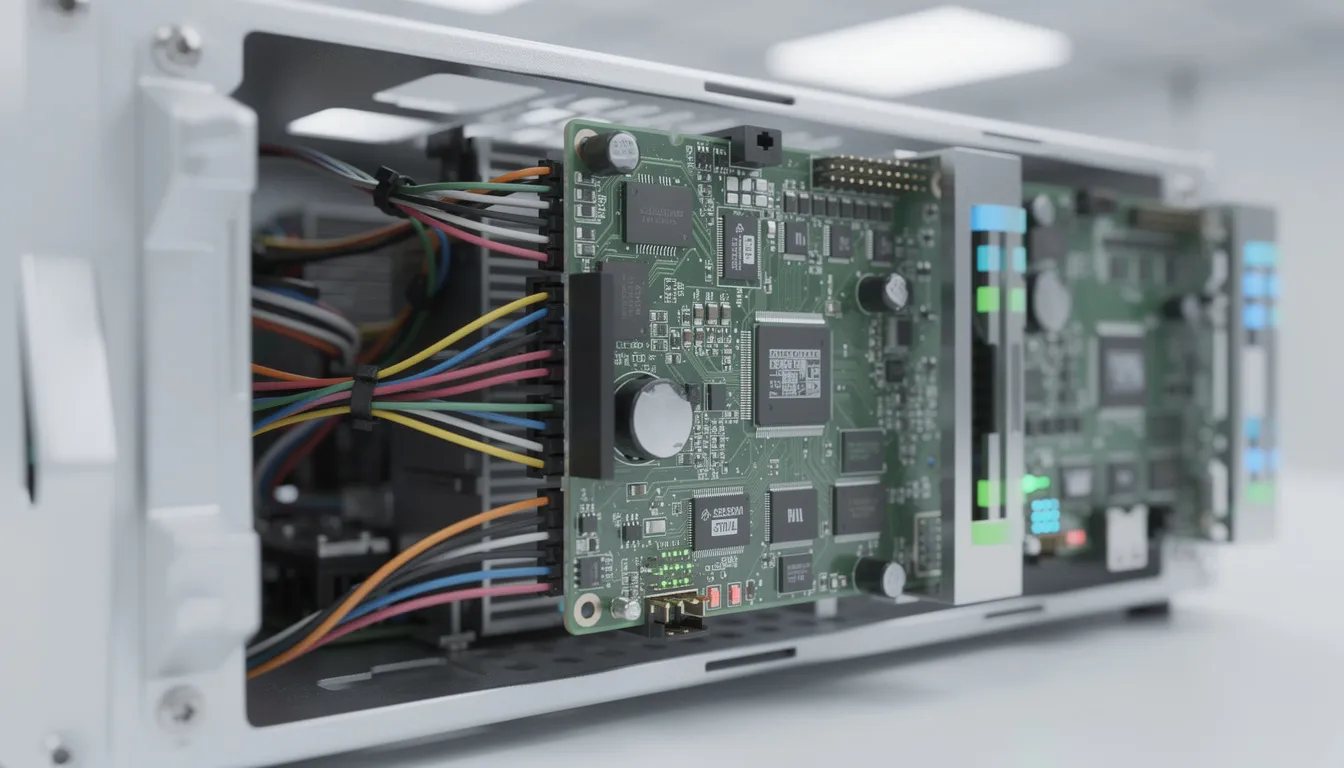
The packaging needs to be tailored to the specific server form factor and configuration. A 1U rack server is a different beast to a 42U rack, which is a different beast again to a modular blade chassis. One-size-fits-all just doesn’t cut it.
Rackmount servers are the most common type in enterprise environments – but they present a problem with their thin profile and substantial weight. You need a rigid outer carton with lots of foam padding to keep it from bending and to keep the mounting ears and rails intact.
And don’t even get me started on the weight at the front of these things – you need foam inserts that can distribute the load evenly across the package.
Fully populated racks are the hardest to ship – 42U, 45U or 48U configurations that weigh a ton when they’re fully loaded. Crating and transporting them requires specialist knowledge to manage the centre of gravity, prevent rack sway during transport and protect the protruding components.
Tower servers and small office servers are a bit easier to ship – but still need anti-static cushioning and proper isolation from other freight on the pallet. They’re not as heavy, but are still vulnerable to impact and vibration damage.
Server Type (see our professional packing and shipping services) | Typical Weight | Primary Packaging Approach |
|---|---|---|
1U Rackmount | 30–50 lbs | Rigid carton with molded foam |
2U Rackmount | 50–75 lbs | Double-wall box, dense cushioning |
4U Rackmount | 75–100+ lbs | Reinforced carton, palletization |
Full Rack (loaded) | 800–2,000 lbs | Engineered crate with bracing |
Tower Server | 25–60 lbs | Double-wall box, foam corners |
Using dodgy packaging can end up causing three main problems: physical damage to the hardware, data integrity issues, and delays to your project. Each one’s a big deal and can end up costing you a lot more in the long run than just replacing a piece of kit.
Packaging shortcuts are pretty predictable – single-wall boxes get bashed by stacking, packing peanuts let servers get knocked around causing damage to the box and the hardware, and off the shelf boxes just aren’t built strong enough to handle valuable gear. That means you get crushed corners, bent chassis, and all sorts of other fun problems.
And to make things even worse, the LTL freight networks that move your gear around can subject it to huge shock forces – 10-15g or more – that your packaging better be able to withstand if you don’t want to end up with a bunch of broken gear.
It’s not just the hardware that’s the problem – even if your gear looks fine on the outside, the inside could be a different story. Hard disk drives are especially vulnerable to those big shocks that can cause the head to crash or leave you with latent sector errors. And you might not even notice anything’s wrong – until it’s too late.
When it comes to dealing with insurance claims, improper packaging is often a major headache. Carriers and insurers will often require all sorts of documentation and proof that you used proper packing methods – and if you didn’t, they can end up refusing to honour your claim.
Sensitive shipments like the gear in your IT server need packaging that not only does the job right, but also gives you a solid basis for any insurance claims down the line.
When you get it right, server packaging is all about balancing a bunch of different protection functions – shock absorption, vibration dampening, static protection, keeping the moisture out, and keeping your gear locked down tight. It’s all about getting these functions working together like a well-oiled machine.
Here are some of the key tech principles that underpin server packaging:
When it comes to server packaging, OEM (that’s original equipment manufacturer – Dell, HPE, Lenovo and the like) is the reference standard. OEM packaging is all about performance and is engineered to meet the specific needs of each server model. If you can’t use OEM packaging, you’ve got to do your best to match it.
Getting the labelling right is crucial – it ensures that everyone from the warehouse to the delivery driver knows what to do with your gear.
Not all packaging materials are created equal when it comes to shipping sensitive electronics like your IT servers. You need the right materials with anti-static properties and proper foam cushioning – generic fillers and cheap off the shelf packaging products just won’t cut it.
You need some serious protection for the outside of your gear – we’re talking:
Inside your box, you need materials that can absorb shocks and keep your gear safe:
Static electricity poses a real threat to electronic components. Anti-static bubble wrap and those pink anti static bags that everyone uses will protect against electrostatic discharge when you’re handling gear. Standard bubble wrap provides some protection but its lacking in the ESD department-a critical distinction for shipping computers and other IT kit.
Avoid using that cling wrap or standard plastic sheeting to wrap up exposed electronics. These sorts of materials can generate static charges that can really damage sensitive components.
Other suitable packaging materials that you might want to consider include:
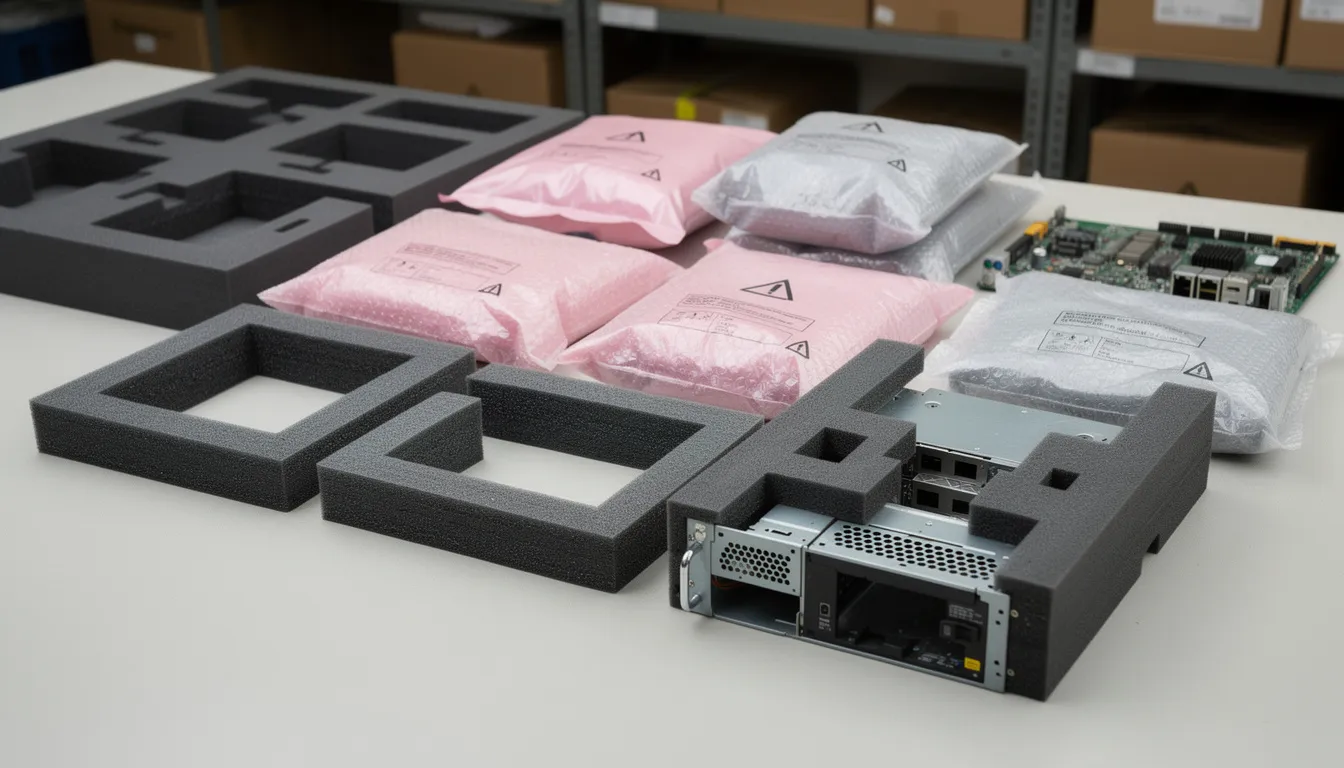
Rackmount servers in the 1U-4U form factor – like the Dell PowerEdge R740 and the HPE DL380 Gen10 – are heavy at the front because that’s where the drives and power supplies are, and you need to package them right to prevent bending and protect front-panel components from damage.
Ideally, you would be reusing the original packaging that the manufacturer sent it in. Servers that have been shipped in the last few years will probably still have their original packaging materials, including molded end caps and sturdy cardboard boxes designed specifically for the model. These need to be inspected for damage before you reuse them – if the foam is crushed or the carton is compromised, it isn’t providing adequate protection.
If you can’t get hold of the OEM packaging for some reason, you need to put the server in custom packaging – it needs to be done carefully:
When you’ve got two servers or more to ship, palletizing is a good idea. Placing servers on pallets will get you forklift handling instead of manual lifting – much safer for the handlers and for the servers
You do this by:
If additional protection for fragile items is needed, consider using foam solutions.
You can’t use the same packaging methods to ship a fully loaded rack as you do for empty racks or individual servers. A rack with all the kit in is basically a complicated assembly that can’t be transported safely using conventional methods
A fully loaded enterprise rack weighs 400-900kg and is a big footprint – 600mm x 1000mm – and is top heavy because of all the kit in it. That makes it a real challenge for transport stability and handling at loading docks and ramps.
A custom crate for a loaded rack has to be designed to withstand the rigors of the transport. You need:
Component | Function |
|---|---|
Solid plywood base | Supports forklift entry and distributes weight |
Steel or lumber bracing | Prevents rack sway during acceleration/deceleration |
Ramps or skid systems | Enables safe loading and unloading |
Removable side panels | Allows inspection and safe unloading at destination |
HDPE shock pallet | Absorbs impact forces during handling |
Solutions like the Enconnex InfiniRack packaging system use heavy-duty reinforced anchoring brackets on shock pallets of engineered plywood sandwiching high-density polypropylene foam, supporting up to 3,000 pounds and independently verified to meet ISTA 3E standards. For other innovative approaches, see this server rack shipping case designed for secure and cost-effective transport. | |
Before crating, you need to secure the internal components:
You can’t ship a fully populated rack in basic cardboard wrap or blanket only protection – that is fundamentally unsafe. You need engineered crating with tested foam densities and clear center-of-gravity handling markings to get these high-value assemblies safely from A to B.
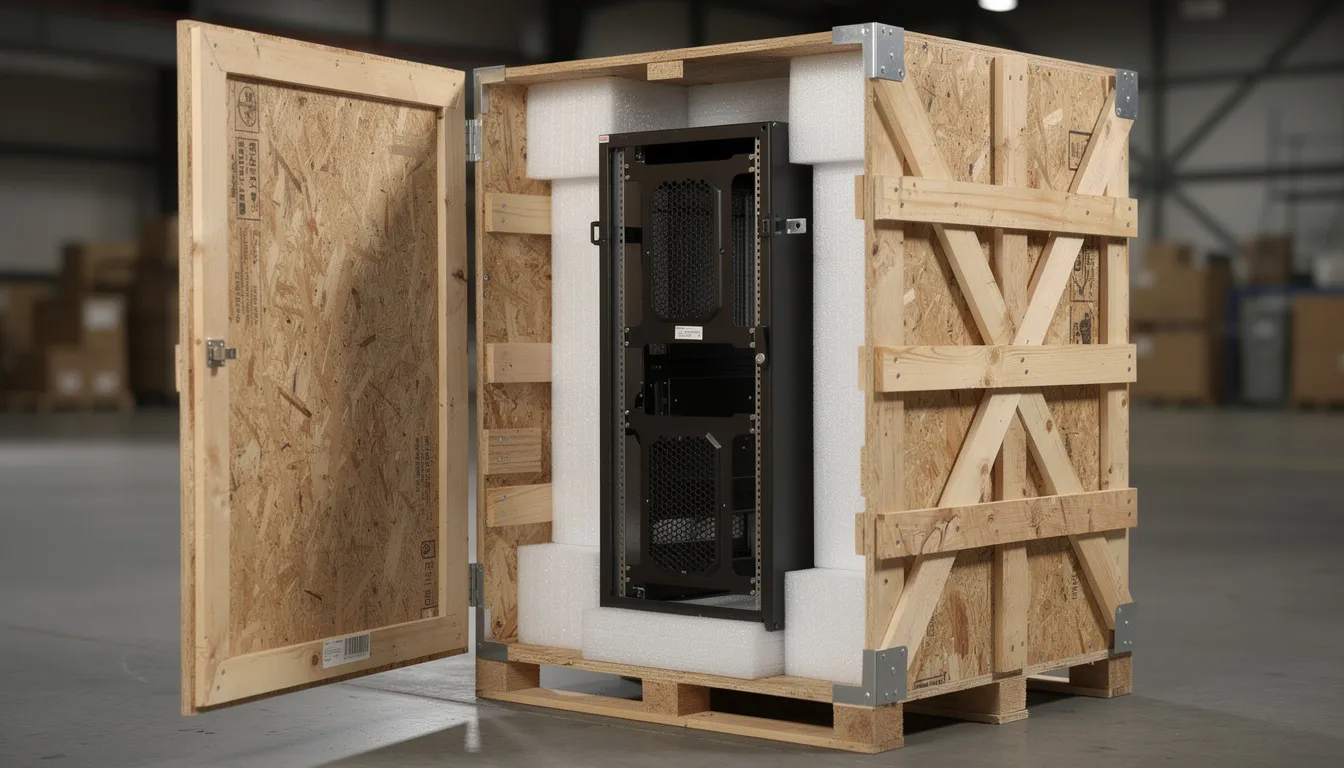
When you are shipping servers across the globe – like between the US and the EU or the US to APAC – you need to think about the additional hazards that your kit will be exposed to, beyond the local transport. These can include more handling events, climate variations, and customs inspections, which increase the reliance on correctly engineered packaging.
International shipments may encounter significant temperature and humidity changes during transit and storage. To protect the kit you need:
Non compliant materials can get your shipment refused or seized at the destination country’s border, regardless how well your documentation is done – in fact all the proper paperwork in the world won’t make a difference if your crates don’t meet the ISPM-15 requirements. And some countries have specific restrictions on certain types of wood or foam materials
Customs may need to open your crates to visually or physically inspect them. And to make things easier for everyone, your crate designs should be able to be opened and then closed back up without damaging the interior packaging. Any interior components should clearly be labeled so that customs can easily inspect and re-pack the contents.
Many airlines and carriers require certified packaging standards – such as ISTA-tested designs – for high-value IT cargo. Meanwhile, if you’ve got poorly designed packaging on a rack, it may get refused at the origin airport or the first transfer point, and you may end up having to re-pack in a rush.
When shipping internationally, its not just the packaging that is important – but also the paperwork:
The following is a practical chronological flow of steps that project managers and IT leads can follow when relocating or deploying servers.
Correct packaging is a relatively small percentage of the total cost of a project, but its impact on risk mitigation makes it well worth the investment.
Consider a $80,000 rack deployment scheduled for 2025. Engineered crating and white glove handling adds around $2,000-$3,000 to the cost. This is less than 4% of the hardware cost. But if one of your racks gets damaged to the tune of $20,000 or more – plus the time and effort to rebuild – it far exceeds the value of the packaging investment.
Industry data indicates a big difference in damage rates based on the quality of the packaging:
Packaging Approach | Typical Damage Rate |
|---|---|
Generic packaging in LTL freight | 2–5% of shipments |
OEM or engineered packaging | Near-zero |
For organizations shipping servers regularly, even a 2% damage rate creates substantial cumulative costs over time. |
Beyond direct cost savings, proper packaging also helps:
For most organisations, engineered packaging becomes cost-neutral or even net-positive after avoiding just one serious damage incident. Given the high value of server equipment, this threshold is typically reached very quickly in any active IT environment
Organisations that only do this type of thing occasionally benefit from partnering with specialists who do this every day. The learning curve and tooling requirements for proper server packaging make in-house capabilities only cost-effective at a certain scale
Packaging engineers design custom crates and foam sets for specific server models and the like. Using CAD tools and data from past ISTA testing, they create solutions tailored to the exact dimensions, weight distribution and vulnerability of each configuration. This expertise ensures that other IT equipment gets the optimal protection needed without over-engineering costs.
Specialist logistics providers offer comprehensive services including:* Packing up your gear on-site at the data centre – no need for a dock
When you outsource all the different bits of the shipping and packing process to one company – the packaging design, the materials, the crates, the transport, the insurance and the final placement – you avoid all the hassle of trying to get different people to talk to each other. It saves you a load of administrative work, and makes sure that if something does go wrong, you know exactly whose fault it is.
Especially when you’re doing a big migration, or building a whole new data centre from scratch, or rolling something out across a load of different countries between 2024 and 2026, going with a single provider makes a massive difference. The cost of using a professional is usually recouped by avoiding all the damage, getting your gear deployed quicker and using fewer of your own staff.
If you’re missing your Dell, HPE, Lenovo or similar supplier boxes for your servers you need to get some proper replacement boxes. You can’t just chuck it in a generic box and hope for the best – that’s a sure fire way to damage the thing on the way to its new home. Instead you get a custom made box with a proper foam insert that’s the right size for your server and weight. Don’t even think about using some office moving box or a load of loose fill packing material – that’s just a recipe for disaster. Get a proper box that’s designed for the job, and if you’re shipping a load of high-value gear or more than a few units, it’s worth investing in a custom made box.
Shipping a rack with the servers still in it is technically possible – but only if you’ve got a special crate designed for that very purpose. That crate needs to be specially made to take the weight and stress of all the gear inside, and it needs to be made to the supplier’s specs.
Don’t even think about trying to ship a rack with the gear still in it in some standard box or with just a blanket to keep it in place – that’s a disaster waiting to happen. Check the supplier’s guidelines – some of them are updating their guidelines all the time – to see if shipping a rack with the gear in is allowed and what extra precautions you need to take.
If you just have a few racks to move, you can probably get away with starting planning the packaging about 6 to 8 weeks in advance. That gives you time to design the crates, get the materials, and test everything out.
But if you’re planning a big move, or a multi-site operation, you need to start planning at least 3 to 4 months in advance. That’s because you need to get all the crates ordered, arrange with the carriers, and try to fit in with all the other people who are moving gear at the same time.
There’s no one specific standard just for servers – but a lot of people use the ISTA (International Safe Transit Association) standards to make sure that their gear isn’t going to get damaged in transit. The ISTA 3E test is a good example – they drop the crate, give it a good old fashioned bashing around and test it to see if it’s up to the job.
If you’re shipping batteries or other flammable materials, IATA and UN regulations come into play too. When you’re looking for a packaging company, ask them if they do ISTA testing, and what certifications they have. That way you can be sure that your gear is going to get to its new home safely.
Packaging keeps the hardware safe, but data security is another matter entirely. Before you move the servers, make sure you’ve got a full backup – not just of the data, but of the server itself. Make sure disk encryption is turned on, and think about secure wiping any data from the drives when you’re done with it. If it’s super sensitive, consider shipping the data separately – or even shipping encrypted drives with tamper-evident boxes and all the security papers. If you’re in a regulated industry, make sure you’ve got written procedures for both packaging and data handling that match up with your compliance obligations.